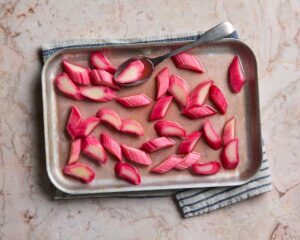
Out of season, yet perfectly timed: Yorkshire forced rhubarb adds a pop of bold colour and sharp flavour to sweet and savoury dishes alike. With its striking candy-pink stalks and frilly yellow-hued leaves, it’s as beautiful as it is refined.
Yorkshire forced rhubarb is actually grown indoors, in complete darkness. The roots spend two years outdoors, exposed to hard winter frosts that send the plant into dormancy, before being transferred to heated, pitch-black ‘forcing sheds’. There, the warmth triggers a sudden burst of growth (so rapid, growers speak of hearing creaks and pops as the stalks are ‘forced’ from the earth).
Born in the dark
Growing forced rhubarb in total darkness prevents photosynthesis, so stalks are sweeter and more tender than their outdoor-grown counterparts. The absence of light also preserves the plant’s vivid pink hue. When the crop is ready, skilled growers harvest by candlelight to limit any exposure to light. It is meticulous, physical work (and a real labour of love).
But the first crop of forced rhubarb grew by complete accident. In 1817, gardeners at London’s Chelsea Psychic Garden unwittingly covered up leftover rhubarb roots with soil. Weeks later, they discovered unusually long, pale-pink shoots emerging from the ground, with a sweet flavour unlike regular rhubarb.
The Rhubarb Triangle
By the late 1870s, growers from West Yorkshire had developed the world’s first purpose-built forcing sheds, allowing rhubarb to be produced on an industrial scale. Now known as ‘The Rhubarb Triangle’ (a 9-square-mile area in West Yorkshire), the area went on to supply an estimated 90% of the world’s forced rhubarb at its peak.
The region’s cold winters were key, pushing the plants into dormancy, while fertile soils supported strong root growth. Just as important was the industrial revolution. Coal from nearby mines provided cheap fuel to heat the forcing sheds, and railways made it possible to transport it quickly. Overnight ‘Rhubarb Express’ trains ran from Wakefield to London markets, so that freshly-cut stalks could be sold the very next morning.
Rhubarb renaissance
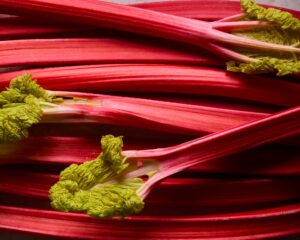
Yorkshire forced rhubarb’s boom came to an abrupt halt in the 1960s and 1970s. Imported exotic fruit started to fill supermarket shelves and small rhubarb fields were sold off for housing developments, and the industry rapidly declined. The number of growers went from over 200 to just 12.
But the good news is: forced rhubarb is having a renaissance. In 2010, Yorkshire forced rhubarb earned Protected Designation of Origin (POD) status, meaning only rhubarb grown using traditional methods in the Rhubarb Triangle can legally bear the name. Today, you’ll find Yorkshire forced rhubarb on menus around the world – including ours!
The good-for-you part
Yorkshire forced rhubarb is a source of vitamin K, which is a nutrient to support normal bone health when part of a balanced diet and lifestyle. A 100g serving also contains around 2.4g of fibre and It’s also a source of manganese – a mineral involved in normal energy metabolism and protecting cells from oxidative stress – with one portion providing more than 20% of your daily requirement.
Ways with forced rhubarb
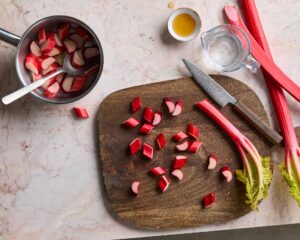
Transform Yorkshire forced rhubarb into a vibrant compote, sweetened with sugar or honey to balance its tartness. It’s delicious teamed with decadent roast duck or juicy steaks to cut through its richness, or paired with delicate sea bass. Or, clank it up and roast it to release its natural sweetness and bring a new dimension to your favourite noodle dish. The possibilities for deliciousness are endless.